How To Track Competitors Ads Without Guessing
Feb 17, 2026
Why Competitor Ad Tracking Matters More Than Ever
Creative is now the biggest performance lever in paid media.
CPMs fluctuate.
Algorithms evolve.
But messaging? Messaging compounds.
If a competitor is running the same ad for 60, 90, even 120 days — that ad is profitable.
Brands don’t keep losing ads live for fun.
Long duration equals sustained return.
And sustained return equals structure you can learn from.
When you track properly, you can:
Identify which hooks survive market fatigue
Detect emotional positioning shifts
Spot seasonal messaging pivots
Understand persona targeting direction
Reverse engineer offer structure
This isn’t spying.
It’s market intelligence.
TL;DR
Track competitor ads by focusing on duration, not design. Ads running 30+ days are profitable signals. Identify the persona, analyze emotional tone, and monitor messaging shifts over time. Using Heystak’s Discovery, Persona Analysis, Emotional insights, and Ad Tracker turns ad browsing into structured market intelligence you can scale from.
Step 1: Stop Looking at Ads. Start Looking at Duration.
Most marketers get distracted by aesthetics.
They see:
High production quality
Great lighting
Polished UGC
Viral comments
None of that guarantees profitability.
The strongest performance signal available publicly is duration.
How long has the ad been active?
Inside Heystak’s Discovery view, you can filter by runtime and instantly surface ads running 30+, 60+, even 100+ days.

That changes everything.
Because now you’re not guessing what works.
You’re analyzing what has already survived.
And survival in paid media is data.
When you isolate long-running creatives, patterns emerge:
Faster product reveals
Direct hooks
Clear problem statements
Repeated emotional tone
Duration removes opinion.
It leaves structure.
Step 2: Understand Who the Ad Is Actually Talking To
Broad targeting is dead.
The highest-performing ads speak to a specific persona.
Not “women 25–44.”
But:
“New mums struggling with hormonal acne.”
“Founders scaling their first $100k/month store.”
“Men training for their first marathon.”
Every strong ad has implied audience positioning baked into the script.
The language gives it away.
The pain point gives it away.
The emotional tone gives it away.
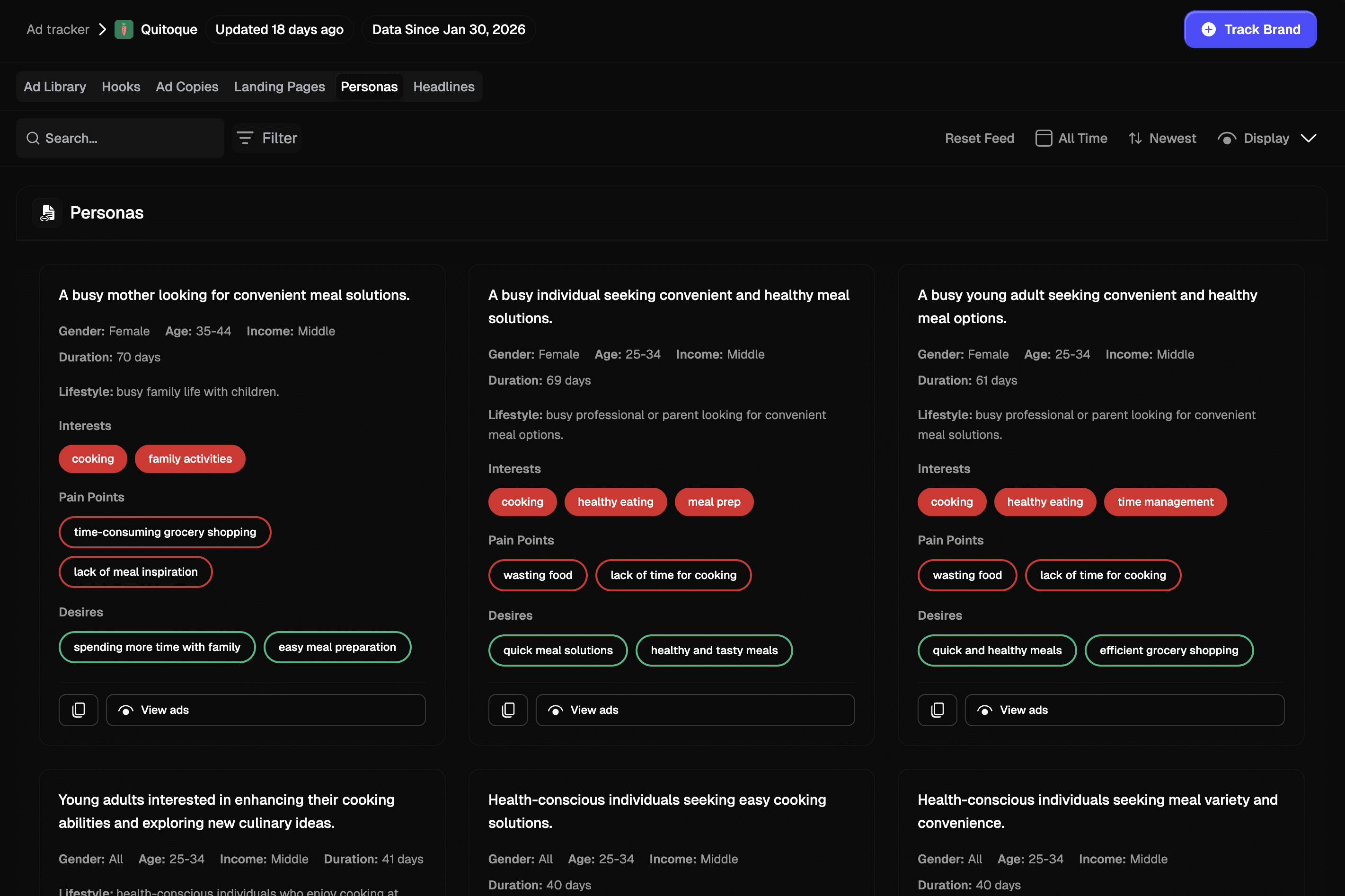
Inside Heystak, Persona Analysis breaks down who the ad is likely targeting based on messaging, framing, and structure.
Why does this matter?
Because copying a hook without understanding the persona behind it is useless.
If an ad says:
“I tried everything for my skin and nothing worked.”
That resonates differently with:
Teenagers
Women in their 30s
Post-pregnancy mums
The hook is identical.
The persona context changes performance entirely.
When you analyze persona patterns across long-running ads, you begin to see:
Which demographics brands are scaling toward
Which audience segments convert consistently
Where competitors are doubling down
Now you’re not just tracking ads.
You’re tracking audience direction.
You can track brands in Heystak and see exactly who the personas are they they're targeting.
Step 3: Map Emotional Patterns (This Is Where Most Brands Fail)
Winning ads aren’t emotionally random.
They cluster.
Health brands lean heavily on Authority + Aspiration.
Fashion brands often combine Identity + Belonging.
Drop brands drive Urgency + Scarcity.
Skincare frequently sits in Trust + Relief.
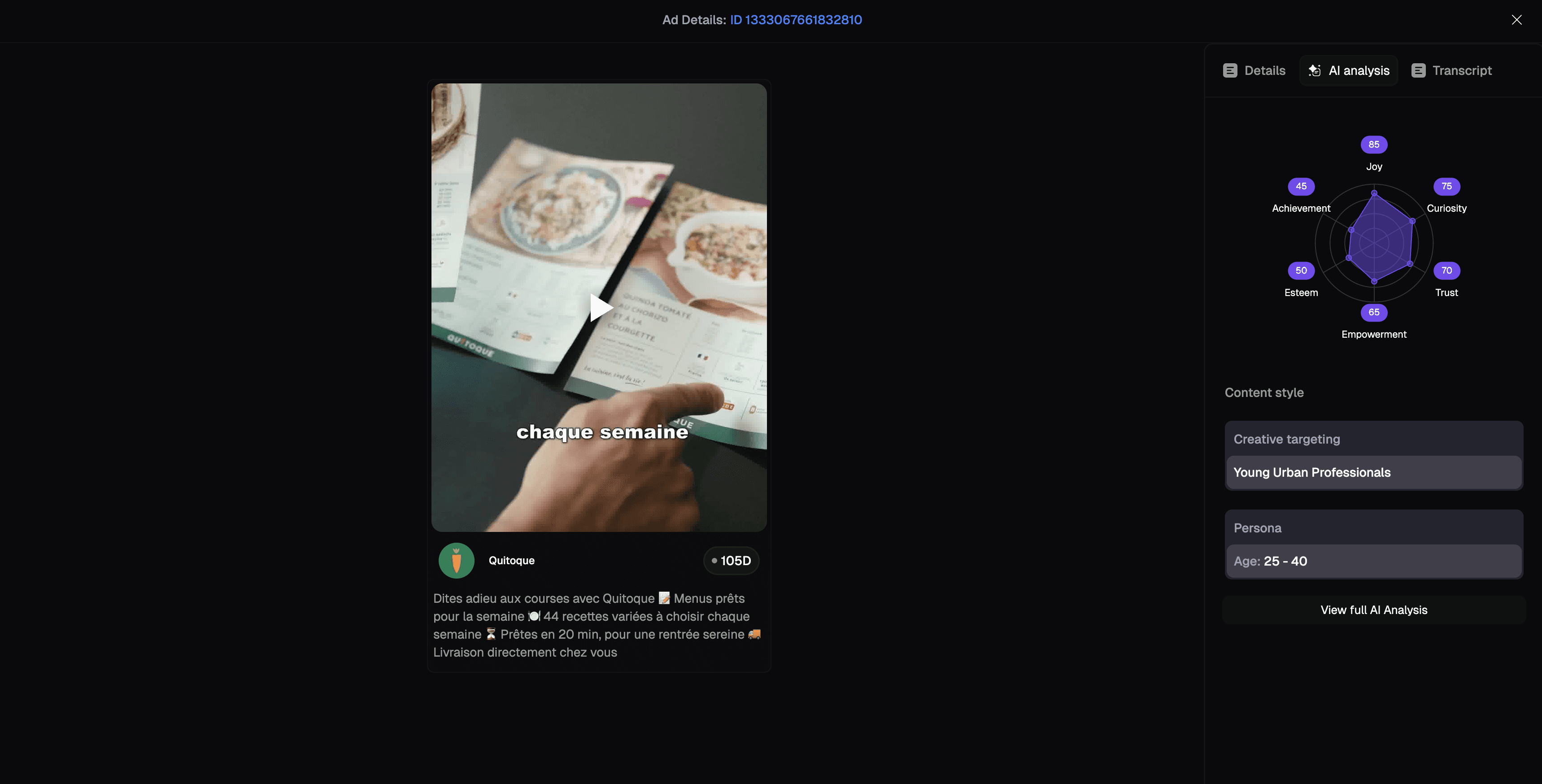
Inside Heystak, the Emotional Scattergraph reveals dominant emotional signals within a creative.
This removes vague feedback like:
“This ad feels strong.”
Instead, you see:
48% Authority
27% Aspiration
18% Urgency
Why does that matter?
Because emotional tone influences longevity.
Ads that rely purely on hype burn out fast.
Ads that layer authority and trust sustain longer.
When you analyze competitor ads through emotional distribution instead of surface-level copy, you begin to see repeatable patterns.
And repeatable patterns scale.
Step 4: Track Changes Over Time (Not Just Snapshots)
Most brands check competitors reactively.
They see a viral ad and panic.
Real tracking is longitudinal.
It asks:
How often do they refresh creative?
When do they duplicate angles?
What happens before they scale?
When do they pivot messaging?
Heystak’s Ad Tracker allows you to follow specific brands and get notified when new creatives launch.
This is where strategy lives.
If a competitor:
Suddenly moves from aesthetic UGC to founder-led authority
Shifts from benefits to pain-point heavy hooks
Introduces urgency into previously evergreen messaging
That’s not random.
It’s performance-driven.
And if you catch it early, you adapt faster.
Tracking over time reveals direction.
Direction reveals opportunity.
Step 5: Look for Structural Repetition
When a brand duplicates an ad format across variations, that’s a signal.
It means the structure works.
Watch for:
Same hook, different testimonials
Same script, different creators
Same angle, slight emotional variation
Structure repetition is performance validation.
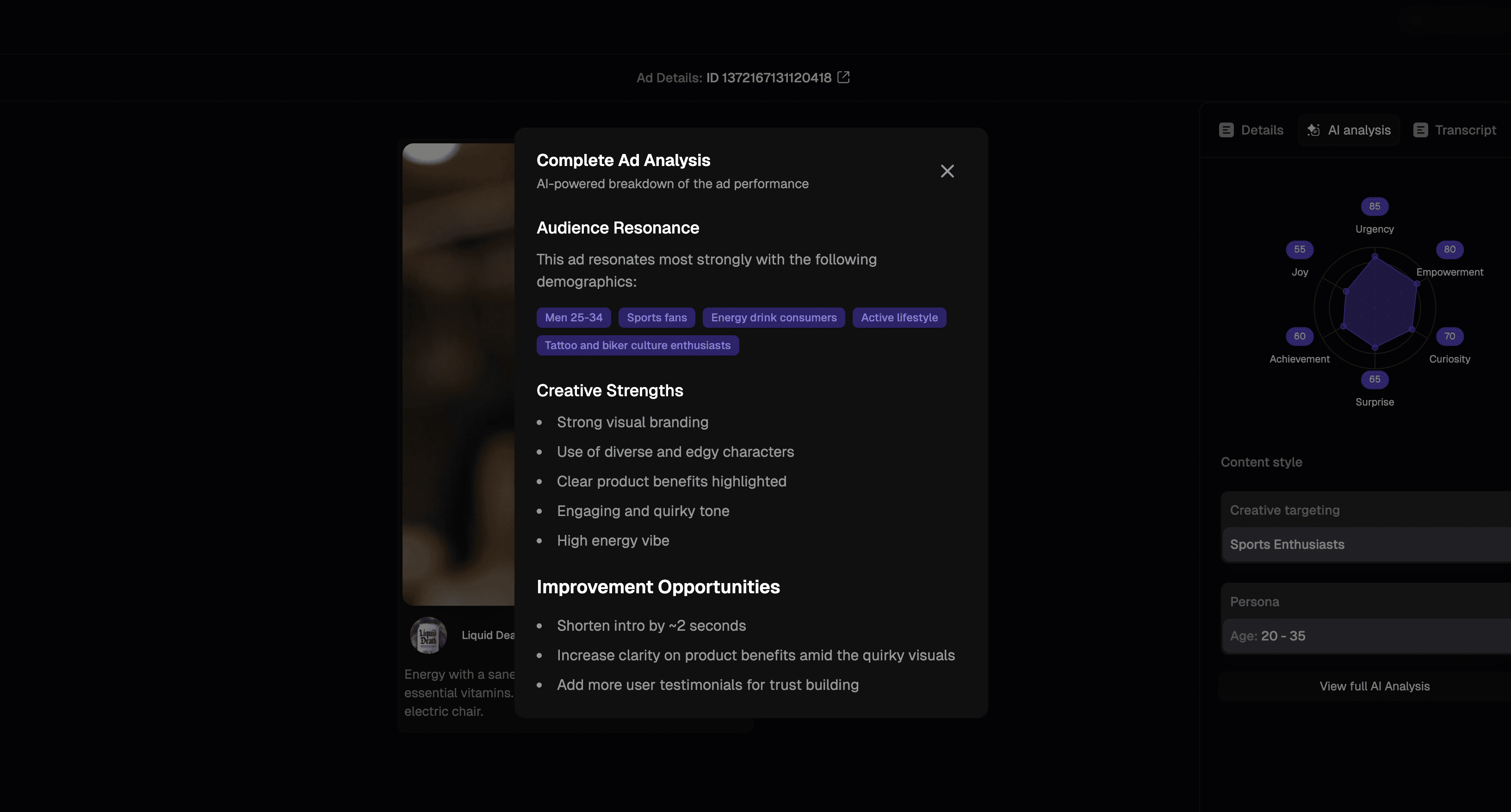
Inside Heystak’s Full Ad Breakdown view, you can analyze:
Audience resonance summary
Creative strengths
Improvement opportunities

Instead of asking:
“Why is this working?”
You see a breakdown of likely performance drivers.
This changes creative meetings from subjective debates into structured analysis.
Step 6: Extract Patterns, Don’t Copy Ads
The goal isn’t replication.
It’s extraction.
You’re not copying:
Their footage
Their creator
Their branding
You’re extracting:
Hook structure
Emotional layering
Persona framing
Offer clarity
Proof positioning
When you combine Discovery filtering (by duration), Persona analysis, Emotional mapping, and Ad Tracker monitoring, you build a competitive intelligence system.
And systems outperform guesswork.
The Real Advantage of Competitor Ad Tracking
The biggest mistake brands make is reacting emotionally to competitor ads.
They see something working and say:
“We need that.”
Instead of asking:
“Why is that working?”
Tracking properly gives you answers to:
What market pain is being amplified?
What emotional tone sustains performance?
What personas are profitable right now?
What structures are scalable?
When you track intelligently, you stop testing randomly.
You test strategically.
And strategic testing lowers CPA.
Final Thoughts
Competitor ad tracking isn’t about ego.
It’s about clarity.
The brands that win aren’t the most creative.
They’re the most aware.
When you combine:
Duration filtering
Persona breakdowns
Emotional analysis
Ad Tracker monitoring
Structural evaluation
You’re no longer guessing what works.
You’re reading the market in real time.
And the market always tells you the truth.